
By Florian Konrad, Unicorn Factory. Data collected on 17 October 2026.
The 7-minute video: Your Customers Use ChatGPT. But Does It Recommend You? It shows the hidden searches live in Chrome and walks through the results.
Key findings
Before ChatGPT recommends a product, it runs its own web searches. We pulled those searches out of 24 real buying questions. In most cases the first search already contained the brand names that later ended up in the answer, and most of the pages the search returned were not the websites of the recommended products but comparison portals, review blogs, top lists and media.
| 21 of 24 | questions in which ChatGPT’s very first search named brands that were not in the question |
| 80 of 110 | recommended products (72.7%) that were already named in ChatGPT’s own search queries |
| 256 of 332 | search results (77.1%) that did not come from the websites of the recommended products |
| 11 of 11 | runs of the same CRM question in which HubSpot came first |
All numbers come from a public dataset that you can download at the end of this article, together with the script that reproduces them.
Method
Tool. We used the DataForSEO AI Optimization API, “ChatGPT LLM Scraper”, endpoint ai_optimization/chat_gpt/llm_scraper/live/advanced. For each question it returns ChatGPT’s answer, the search queries ChatGPT issued in the background (field fan_out_queries), the search results its search tool returned (search_results) and the links shown in the answer (sources).
Date and location. All 34 requests ran on 17 October 2026 between 15:43 and 15:48 UTC. The 12 English questions used the location United States (code 2840, language en), the 12 German questions Germany (2276, de), desktop device. The scraper reports the model as gpt-6 in every response; we could not verify this independently. Each request cost 0.004 US dollars.
Questions. 24 buying questions of the type “What is the best … ?”, one request each. None of them contains a brand name.
| ID | Question | ID | Question |
| en01 | What is the best AI note-taking app? | de01 | Welche CRM-Software ist die beste für den Mittelstand? |
| en02 | What is the best CRM for small businesses? | de02 | Was ist die beste Buchhaltungssoftware für Selbstständige? |
| en03 | What is the best project management software for agencies? | de03 | Welches ERP-System eignet sich für mittelständische Maschinenbauer? |
| en04 | What is the best accounting software for freelancers? | de04 | Was ist die beste Projektmanagement-Software für Agenturen? |
| en05 | What is the best email marketing tool for ecommerce? | de05 | Welcher Webhosting-Anbieter ist der beste in Deutschland? |
| en06 | What is the best website builder for a small business? | de06 | Was ist die beste Lohnabrechnungssoftware für kleine Unternehmen? |
| en07 | What is the best password manager for teams? | de07 | Welche SEO-Agentur ist die beste in Deutschland? |
| en08 | What is the best HR software for a 50-person company? | de08 | Was ist der beste Website-Baukasten für kleine Unternehmen? |
| en09 | What is the best ERP system for mid-sized manufacturers? | de09 | Welche Zeiterfassungs-App ist am besten für Handwerksbetriebe? |
| en10 | What is the best SEO tool? | de10 | Was ist die beste DSGVO-konforme Newsletter-Software? |
| en11 | What is the best payroll software for small businesses? | de11 | Welcher Passwortmanager ist für Firmen am besten? |
| en12 | What is the best video conferencing software for companies? | de12 | Was ist die beste Videokonferenz-Software für Unternehmen? |
Repeat test. We sent question en02 (“What is the best CRM for small businesses?”) ten more times, so this question has 11 runs. Later that day we sent en01 twice more as a live check.
Coding. We read every answer and coded by hand:
- Recommended products are the items of the answer’s numbered list. Products that only appear in an introduction or a comparison table do not count.
- A recommended product counts as named in a search query if the query contains its name or the vendor’s brand on its own (“Zoho” for Zoho CRM). It does not count if the query names a different product of the same vendor, for example “SAP Business One” for the recommendation “SAP S/4HANA”.
- Every search-result domain was assigned to one of seven categories: site of a recommended product, site of another vendor in the same market, media, comparison and review portals, review blogs and top lists, forums and video, and other. We checked the homepages of the domains on 17 October 2026 and flagged unclear cases.
Limits. This is a snapshot: one day, one model, one answer per question, 24 questions about software and service providers, two locations. The scraper uses ChatGPT without a logged-in account, so there is no memory or personalisation; answers for logged-in users can differ. The search_results field lists what ChatGPT’s search tool returned. Whether ChatGPT opened each of those pages cannot be observed, which is why we say “returned” or “pulled up”, not “read”. Treat the percentages as directional, not as estimates for ChatGPT in general.
Results
1. The first search already contains the shortlist
In 21 of the 24 questions, ChatGPT’s first search query named at least one brand that did not appear in the question: 12 of 12 in English, 9 of 12 in German. Asked for the best AI note-taking app, ChatGPT’s first and only search read:
best AI note taking apps 2026 Otter Fireflies Notion AI Granola Fathom features pricing
Nobody typed those five names. Four of them ended up in the recommendations.
The three exceptions were all German questions: payroll software (de06), the best SEO agency in Germany (de07) and a time-tracking app for trades businesses (de09). There, the first search contained no brand at all. We come back to these three below.
Two smaller observations: ChatGPT ran between one and four searches per question, 38 in total, and 14 of the 24 questions got only a single search. For three German questions (de08, de11, de12) the first search was in English.

Data: fan_out_queries.csv, column brands_named; summary.json → first_query_names_brand_not_in_prompt.
2. Nearly three out of four recommendations were in the search
The 24 answers contained 110 numbered recommendations. 80 of them (72.7%) were named in at least one of ChatGPT’s search queries, 79 already in the first one. For two more, the query named the vendor but a different product. 28 were not named in any query.
Seen from the other side: the queries contained 94 distinct product and brand names, and 80 of them (85%) ended up on the list. Names that were searched for but not recommended include Notion AI (en01), Wrike (en03), Dashlane (en07), Moz (en10) and STRATO (de05).

Data: recommendations.csv, columns in_first_query, in_any_fan_out_query, brand_in_any_fan_out_query; summary.json → names_in_queries.
3. Where the 332 search results came from
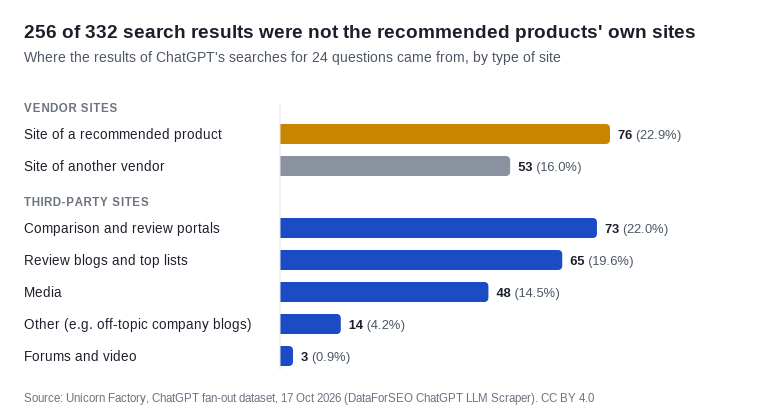
ChatGPT’s searches for the 24 questions returned 332 results from 229 different domains. 76 of them (22.9%) were pages on the website of a product the answer then recommended. 256 (77.1%) were not.
| Type of site | Results | Share |
| Site of a recommended product | 76 | 22.9% |
| Site of another vendor in the same market | 53 | 16.0% |
| Comparison and review portals | 73 | 22.0% |
| Review blogs and top lists | 65 | 19.6% |
| Media | 48 | 14.5% |
| Other (mostly companies outside the category hosting a “best X” list) | 14 | 4.2% |
| Forums and video | 3 | 0.9% |
If you also leave out the sites of other vendors, 203 results (61.1%) came from no vendor at all. Depending on how the unclear domains are counted, that share lies between 58.7% and 68.4%. Comparison portals, review blogs, top lists and media together account for 186 results (56.0%).
The vendor results are concentrated in a few questions. Four of them (de03, de09, en02, de12) account for 48 of the 76 results from recommended products’ sites. In 10 of the 24 questions, not a single search result came from a recommended product’s site. For the AI note-taking question, none of the 12 results came from a note-taking vendor; two of them were “best of” lists on the sites of companies that sell something else entirely, an AI photo app and a set of desktop utilities.
Where vendor sites do show up, it is often for something specific. For the CRM question, ChatGPT’s second to fourth searches were “HubSpot CRM official pricing free tools 2026”, “Zoho CRM official pricing small business 2026” and “Pipedrive official pricing CRM 2026”. For the GDPR newsletter question, three of the four searches were restricted to the data protection pages of rapidmail, CleverReach and Brevo.
One more detail: 107 of the 110 recommendations link to the product’s website in the answer. For 78 of them, that website was not among the search results. A link in the answer is therefore no evidence that ChatGPT looked at the page.
Data: search_results.csv, column category; domains.csv with evidence per domain; summary.json → search_results.
4. Where the shortlist is still open
In the three questions without brand names in the first search, ChatGPT searched generically and worked with what it found. The three cases look different:
- Time tracking for trades businesses (de09). 26 search results, 15 of them from the websites of the products that were later recommended. 10 came from crewmeister.com alone, including Crewmeister’s own comparison pages. Crewmeister was recommended first.
- SEO agency in Germany (de07). None of the five recommended agencies was named in a search, and none of their websites was among the 12 results. Nine results came from agency directories and comparison portals. For three of the five agencies, the answer explicitly refers to the Agenturtipp ranking.
- Payroll software (de06). Eight results: comparison sites, a business newspaper, a founders’ portal, one HR software vendor and one payroll bureau. None of the three recommended products had its own site among the results.
Where ChatGPT has no shortlist yet, it takes it from whatever it finds. In de09, that was largely one vendor’s own content.
Data: search_results.csv filtered to de06, de07, de09; the answer texts are in raw/.
5. Is it a lottery? The same question eleven times
We asked “What is the best CRM for small businesses?” 11 times within four minutes. HubSpot CRM came first in all 11 answers. HubSpot, Zoho CRM, Pipedrive and Freshsales were on every list; Zoho was second in nine runs, Pipedrive in two. Only the fifth place changed: Less Annoying CRM in ten runs, Salesforce Starter Suite once (run 8).
Less Annoying CRM never appeared in a search query. It made ten of eleven lists anyway, which suggests it came from the pages ChatGPT found rather than from the query. Salesforce was named in the queries of runs 8 and 10 but only recommended in run 8.

Data: crm_stability.csv.
6. Live check: the effect repeats
Later the same day, at 17:30 and 17:35 UTC, we sent the note-taking question twice more. The first searches read “best AI note-taking apps 2026 Otter Fireflies Notion AI Granola comparison features pricing” and “best AI note-taking apps 2026 comparison meetings personal notes Otter Notion AI Fireflies Granola”. Both answers recommended Granola, Otter.ai, Fireflies.ai, Notion AI and NotebookLM. Compared with the first run, Notion AI had replaced Fathom. Again, none of the 12 search results per run came from a recommended product’s site.
Data: live_reruns.csv and the two responses in live/.
7. robots.txt: none of the DAX companies locks out AI crawlers
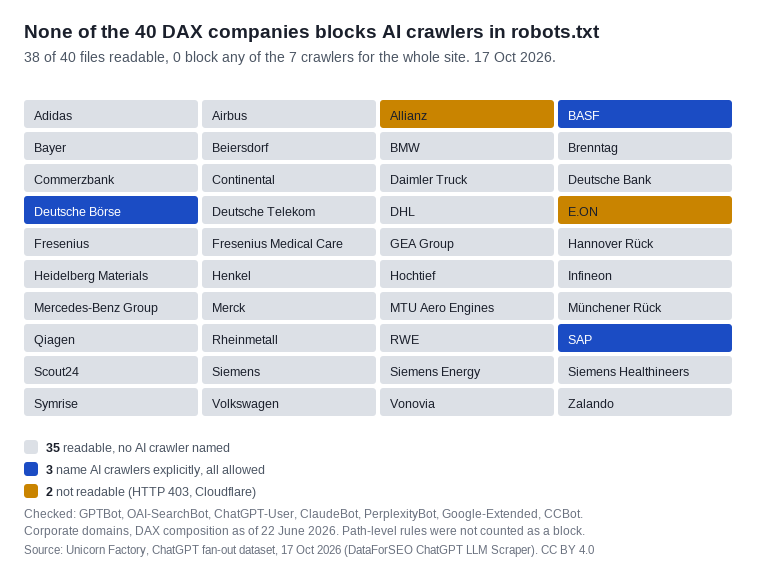
Whether a website can show up in such searches also depends on whether it lets the crawlers in. We checked the robots.txt files of all 40 DAX companies (composition as of 22 June 2026, corporate domains) for seven crawlers: GPTBot, OAI-SearchBot, ChatGPT-User, ClaudeBot, PerplexityBot, Google-Extended and CCBot.
- 38 of 40 files were readable. Allianz and E.ON returned a Cloudflare challenge page (HTTP 403) instead of a robots.txt.
- None of the 38 blocks any of the seven crawlers for the whole site.
- Three companies name AI crawlers explicitly, all with access: BASF (GPTBot, Google-Extended, PerplexityBot), Deutsche Börse (six of the seven, not CCBot) and SAP. SAP takes the opposite route to most: its file shuts out every bot that is not named, and then lists all seven AI crawlers by name with only a few excluded paths.
For context, OpenAI documents that sites that opt out of OAI-SearchBot “will not be shown in ChatGPT search answers”, while GPTBot collects content that may be used for training, and ChatGPT-User visits pages on behalf of a user, where robots.txt rules “may not apply”. A peer-reviewed study presented at the ACM Web Conference 2026 found that 60.0% of reputable news sites disallow at least one AI crawler, compared with 9.1% of misinformation sites.
Data: robots_dax.csv and the robots.txt snapshots in robots-txt/.
How this compares with the big GEO studies
Our sample is small. It becomes more useful next to the studies that are quoted most often in generative engine optimization (GEO), and it is worth knowing who is behind each of them.
Suganthan Mohanadasan, August 2026. He logged ChatGPT’s queries in 27 conversations: in 21 of them the first query contained brands the user never typed, and brands written into the query reached the answer 68.9% of the time, against 2.1% for brands only found on fetched pages. His data come from one logged-in ChatGPT Plus account on 24 and 25 July 2026, mostly about software. Behind it: he built the FanoutFox extension and runs Keyword Insights, and says so. Our setup differs (no login, US and Germany, October), and the result is the same: 21 of 24.
Ahrefs, “Self-promotional content”, July 2026. Ahrefs published 34 self-promotional pages and tracked 9,886 answers from ChatGPT, Gemini, Perplexity and Copilot between 7 February and 31 May 2026. For its conference brand Ahrefs Evolve, 82% of new mentions came in answers that cited one of its own pages. The gains showed up mainly in Copilot (Evolve in 65% of Copilot answers by May); ChatGPT never named Evolve for the test query. For Ahrefs itself, only 6% of new mentions came from answers citing its own pages, 94% from third-party content. Behind it: Ahrefs sells an AI visibility product (Brand Radar) and measured with it. This fits our 77%: for established products, other people’s pages carry the recommendation.
Ahrefs, misinformation experiment, December 2025. Ahrefs invented a luxury paperweight brand, Xarumei, and planted three contradicting fake stories on a blog, Reddit and Medium. Gemini adopted the invented Portland location; Perplexity and Grok repeated invented details as facts. ChatGPT cited the brand’s official FAQ in most answers. Behind it: the same vendor. Relevant here because our open categories (de06, de07, de09) are exactly where whatever ChatGPT finds first shapes the answer.
University of Toronto, September 2025. Chen, Wang, Chen and Koudas asked ChatGPT and Perplexity 50 unbranded questions about cola and soda: 62.2% of brand mentions went to 20 major brands, 9.0% to 20 niche brands. For questions about well-known brands, 93.5% of ChatGPT’s sources were third-party (“earned”) sites, against 63.4% for Gemini. Behind it: an arXiv preprint, not peer-reviewed; the paper thanks the GEO vendor ktau.ai, and co-author Nick Koudas states on his university page that he advises ktau.
Seer Interactive, March 2026. Seer tested 37 signals against ChatGPT visibility for 62 brands in four industries. None was significant in three or more industries; five held up in two, among them mentions in “best of” articles. In B2B payments (14 brands), mentions on TikTok, Wikipedia and news sites went along with lower visibility, mentions in industry publications with higher. Behind it: Seer is an agency; the results are correlations.
Taken together: the studies differ in method and in who paid for them, but they point the same way as our data. ChatGPT’s shortlist is largely set by third-party content, comparison and “best of” pages carry weight, and the vendor’s own site is used for facts rather than for the shortlist.
What you can do on Monday
- Find out whether you are in the search. Ask ChatGPT the questions your customers really ask, several times, and look at the search queries, not only the answer. The section below shows how.
- Get onto the lists ChatGPT finds. Comparison portals, review platforms, trade publications and the top lists in your niche made up 56% of all search results in our sample.
- Make your own site the source of truth for hard facts. Pricing, features, data protection, where you operate. In our data ChatGPT came to vendor sites for exactly that (“official pricing”, data protection pages), and in the Ahrefs experiment it trusted the official FAQ over invented stories.
- In a niche or with a service, move early. Where ChatGPT does not start with names (de06, de07, de09), the shortlist comes from whatever it finds. In time tracking for trades, that was mostly one vendor’s own content.
- Check that you are not locking the door by accident. Look at your robots.txt and at your firewall or bot protection, and check which crawlers they let through. Two DAX companies answered our simple script with a challenge page instead of a robots.txt.
Disclosure
I run Unicorn Factory, a digital agency, and we build our own software for search visibility. Unicorn Factory paid for the data collection: 36 requests including the two live checks, at 0.004 US dollars each. None of the companies, tools or studies mentioned here paid for or commissioned this article. That is why every number comes with its data.
Download the data
The complete dataset is free to use under CC BY 4.0. Each table is available as CSV (UTF-8, comma-separated) and as JSON.
| File | Content | Format |
chatgpt-fan-out-dataset-2026-10-17.zip | Everything below, plus raw responses and script | ZIP |
README.md | Description of every file and column, coding rules, limits | Markdown |
prompts.csv | 34 requests: question, location, model, time, number of searches and results | CSV, JSON |
fan_out_queries.csv | 48 search queries with the brand names they contain | CSV, JSON |
search_results.csv | 473 search results with category (332 in the 24-question sample) | CSV, JSON |
recommendations.csv | 160 recommended products, whether they were searched for and whether their site was among the results | CSV, JSON |
crm_stability.csv | The 11 runs of the CRM question | CSV, JSON |
domains.csv | 242 domains with category and evidence | CSV, JSON |
robots_dax.csv | robots.txt check of the 40 DAX companies | CSV, JSON |
live_reruns.csv | The two live re-runs of the note-taking question | CSV, JSON |
summary.json | All headline numbers of this article | JSON |
mapping.json | All manual coding decisions | JSON |
build-datensatz.mjs | Rebuilds every table from the raw data (Node.js, no network) | JavaScript |
raw/, live/ | Unmodified API responses | JSON |
robots-txt/ | robots.txt snapshots of the 40 DAX companies | Text |
Download: chatgpt-fan-out-dataset-2026-10-17.zip
License: CC BY 4.0. Attribution: “Unicorn Factory / Florian Konrad”. The license covers our compilation and coding; answer texts, page titles and robots.txt files remain the property of their owners.
How to cite: Konrad, Florian (2026): ChatGPT’s hidden searches. 24 buying questions, 17 October 2026. Dataset and article, Unicorn Factory. https://www.unicorn-factory.net/en/chatgpt-hidden-searches-study/ (CC BY 4.0)
How to read the searches yourself
In the normal chat you only see a grey status line such as “Searching …” flicker by while ChatGPT is thinking; after that you see the answer and its sources. There are two ways to read the full searches.
One question, in your own browser
- Ask ChatGPT a question in Chrome (logged in) and wait for the answer.
- Press F12 to open the developer tools and switch to the Network tab.
- Reload the page (F5) so that the conversation data is loaded again.
- Click into the Network panel, press Ctrl+F and search for
search_model_queries. - Click the hit in the conversation request. Under Response you will find the searches in the list
queries.
On 18 October 2026 (model reported by the page as gpt-6-thinking), the question “What is the best AI note-taking app?” produced these searches:
"search_model_queries": {
  "type": "search_model_queries",
  "queries": [
    "best AI note taking apps 2026 Granola Notion AI Reflect Obsidian Otter Fireflies comparison",
    "Granola AI meeting notes pricing features 2026 official",
    "Notion AI meeting notes pricing 2026 official",
    "Fireflies ai meeting notes pricing 2026 official"
  ]
}
The first search already named six products. The three picks at the top of the answer, Granola, Notion AI and Fireflies, were all among them, and the next three searches looked up their prices on the official sites. The field belongs to the ChatGPT web app, is not documented and can change at any time. A logged-in account can also get different searches than our API runs. The video shows this step by step in a screen recording; the searches are in the dataset as chrome_demo_2026-10-18.json.
Many questions, through an API
Through the DataForSEO API the searches are part of the response. You need a DataForSEO account; the API uses HTTP Basic authentication with your API login and password.
POST https://api.dataforseo.com/v3/ai_optimization/chat_gpt/llm_scraper/live/advanced
Authorization: Basic <base64 of login:password>
Content-Type: application/json

[
  {
    "keyword": "What is the best AI note-taking app?",
    "location_code": 2840,
    "language_code": "en"
  }
]
Use location_code 2276 and language_code “de” for Germany. In the response, the queries are in tasks[0].result[0].fan_out_queries:
"fan_out_queries": [
  "best AI note taking apps 2026 Otter Fireflies Notion AI Granola Fathom features pricing"
]
The same result object contains search_results (what the search returned), sources (the links shown in the answer) and markdown (the answer). A request took between 16 and 61 seconds in our runs (field time in the raw responses). Ask each question several times: the CRM test shows that the top of the list is stable, the rest is not.
Sources
- DataForSEO: ChatGPT LLM Scraper API documentation
- Suganthan Mohanadasan: ChatGPT Already Knows Who’s In The Running Before It Searches (10 August 2026)
- Mateusz Makosiewicz, Ahrefs: Self-Promotional Content Works, Until It Backfires (6 July 2026)
- Mateusz Makosiewicz, Ahrefs: I Ran an AI Misinformation Experiment (10 December 2025)
- Mahe Chen, Xiaoxuan Wang, Kaiwen Chen, Nick Koudas: Generative Engine Optimization: How to Dominate AI Search (arXiv preprint, 10 September 2025); Nick Koudas, University of Toronto
- Sonny Vasquez, Seer Interactive: What If the Best GEO Strategy Is the One You Stopped Investing In? (30 March 2026)
- Nicolas Steinacker-Olsztyn, Devashish Gosain, Ha Dao: Is Misinformation More Open? A Study of robots.txt Gatekeeping on the Web (ACM Web Conference 2026)
- OpenAI: Overview of OpenAI crawlers